High Performance
DLP® Subsystems
V-Modules for DMDs
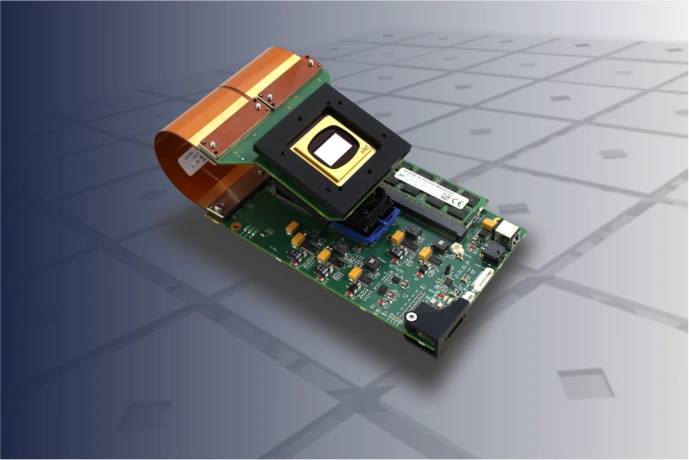
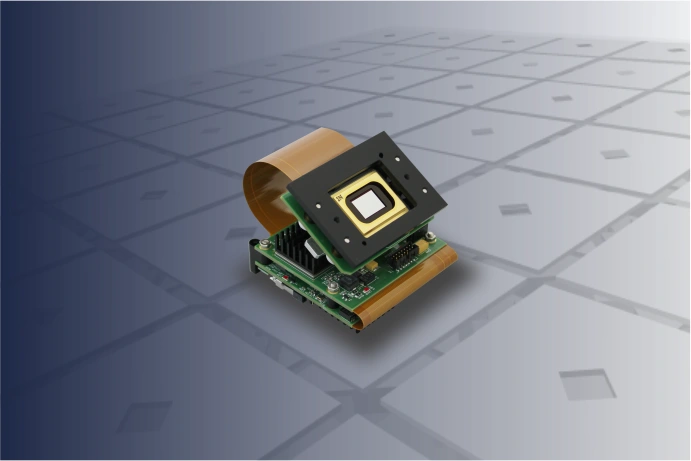
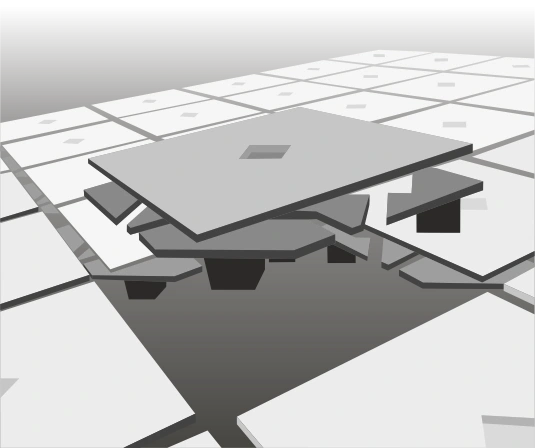
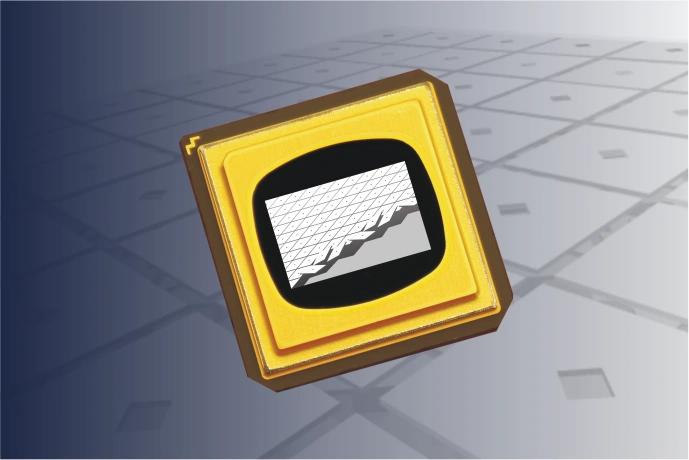
Digital Micromirror Devices (DMDs) are advanced micro-electromechanical systems (MEMS) that form the core of Digital Light Processing (DLP) technology developed by Texas Instruments. A DMD consists of several million microscopic aluminum mirrors arranged in a highly regular array on a semiconductor substrate. Each micromirror represents a single pixel and can tilt between two well-defined angular positions at kilohertz switching speeds. In the “On” position, the mirror directs incident light into the optical path. In the “Off” position, it directs light out of the optical path. By rapidly tilting toward or away from the imaging system, each micromirror modulates light by binary amplitude modulation, enabling precise spatial light control with exceptional speed, stability, and repeatability.
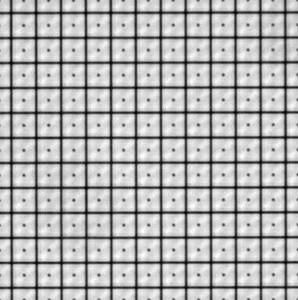
The mirrors are mounted on torsion hinges above an underlying CMOS memory cell that stores the binary state of each pixel. Electrostatic actuation drives the mirrors into their “On” or “Off” states, providing fast switching speeds, high optical efficiency, and excellent contrast. Pulse-width modulation enables grayscale generation, while high-speed pattern sequencing allows binary pattern rates in the tens of kilohertz range, depending on the chipset. Due to their reflective architecture, DMDs support a broad spectral range, from the ultraviolet through the visible and into the near-infrared, making them suitable not only for display applications but also for industrial, scientific, and medical systems.

V‑Modules from ViALUX
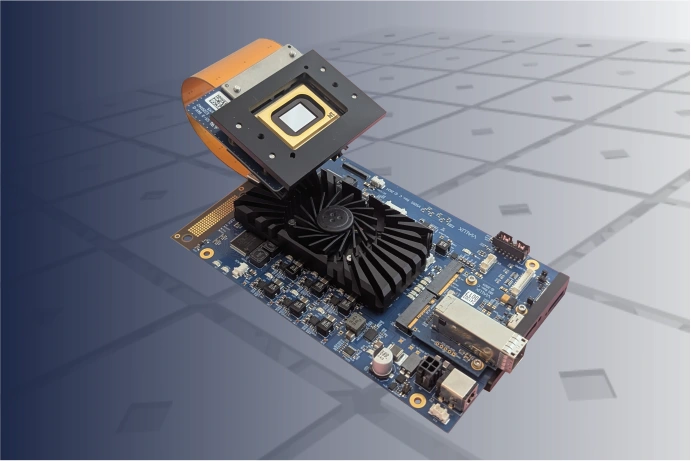
V‑Modules, continuously developed by ViALUX for more than 20 years and manufactured in Germany, represent the highest performance DLP® subsystems available on the market. The functional scope of these V‑Modules and their universal API extend well beyond the capabilities of evaluation modules from Texas Instruments allowing for extremely short development times and provide a state-of-the-art solution for demanding applications.
V‑Modules from ViALUX are proven in industrial use and are designed for maximum performance and reliability, offering a highly advanced platform for integrating the most powerful DLP®controller chipsets from the Texas Instruments. With on-board memory based on SDRAM technology, rather than SSD memory, V‑Modules offer lower latency, and superior real-time data access, ensuring continuous, high-speed data flow to the DMD.
V‑Modules combine the maximum frame rates of the respective DLP®chipsets with a high degree of flexibility for custom control of the micromirror array, enabling a wide range of innovative applications. The usable spectral range extends from 343 nm in the UV to 2000* nm in the NIR and the thermally optimized packages of the DLP®chips allow for optical power densities of up to several 100 W/cm2.
All V‑Modules provide a quick start for DLP®application development. The DLP®subsystems come fully equipped with FPGA logic, firmware, and software. The highly comprehensive and industrially tested ALP programming interface is universally usable and offers full software compatibility across all V-Module models. This saves customers time and costs that would otherwise be required for developing dedicated hardware and firmware.
V‑Modules are well suited for academic research and feasibility studies, and are regularly used as OEM components in industrial DLP®products.